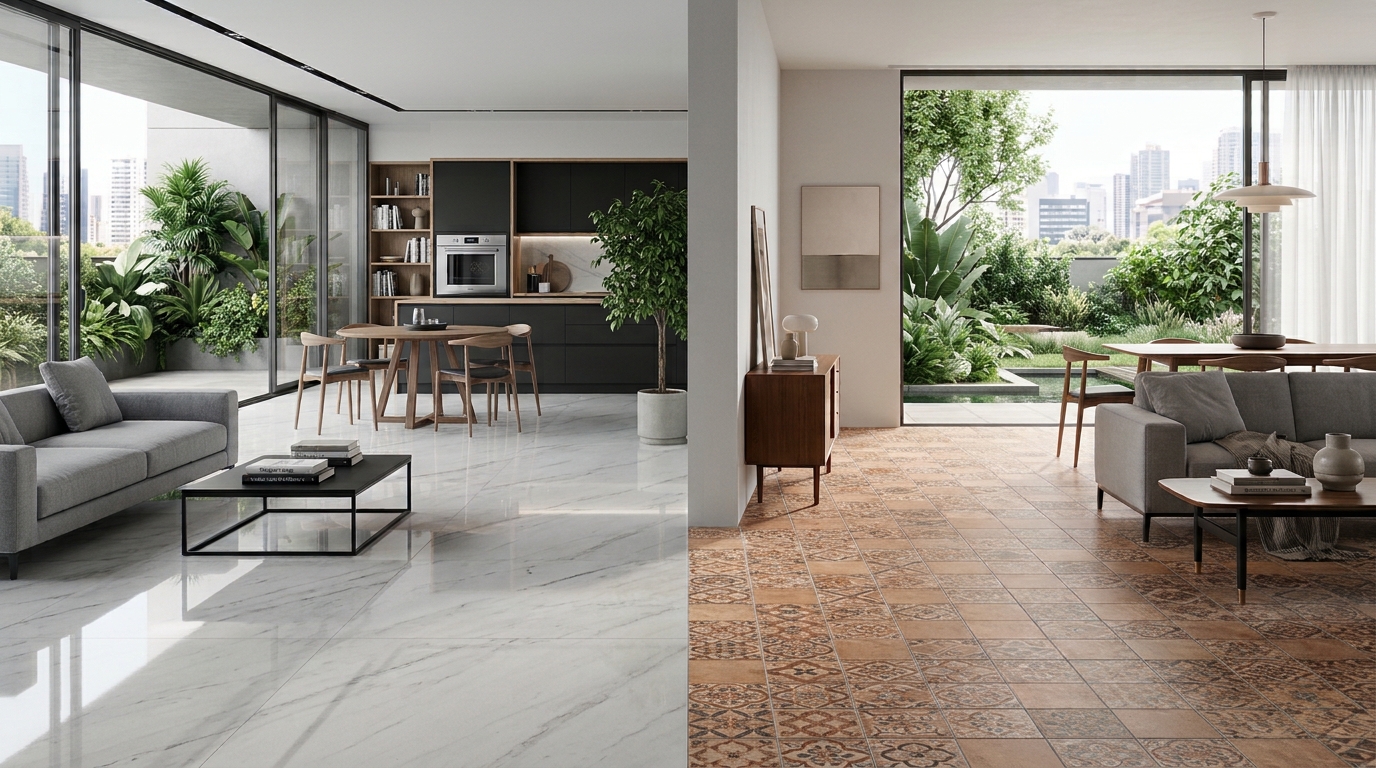
"Which is better, granite or ceramic?" is the question we hear most often in our showroom. The answer depends on the room, your budget and the finished look you want. Both perform well when they're used in the right place and installed the right way.
What is the difference between granite tile and ceramic tile?
Granite tile is also known as porcelain tile or homogeneous tile, and it is not the same as natural granite stone. It is made from a blend of clay, feldspar, silica sand, kaolin and other natural minerals (depending on the manufacturer). The blend is pressed at high pressure and fired at around 1,200°C to 1,230°C, which gives a very dense tile. Granite tile is popular in Indonesia for both modern homes and commercial buildings.
Ceramic tile is also made from clay, which you can usually see on the back of the tile as a brick-red or chalk-white body. It is fired at a lower temperature than granite tile and finished with a glaze on the surface. The pattern and colour sit in that glaze layer. Ceramic tile is still popular in Indonesia because of its wide range of patterns and its lower price compared with granite tile.
| Granite tile | Ceramic tile | |
|---|---|---|
| Durability | Very hard; resists heavy loads, scratches and stains | Hard enough for light to moderate use |
| Popular sizes | 60×60, 80×80, 100×100 cm and more, up to large slabs of 60×120, 120×240, 320×160 cm and more | 30×30, 40×40, 25×40, 30×60 cm |
| Weight | Generally heavier | Generally lighter |
| Cutting | Needs the right cutting tools and specialist installation technique | Easier for a general tiler to cut and lay |
| Price per m² | Generally higher | Generally more affordable |
| Look | Luxurious, elegant and exclusive | Wide variety |
| Maintenance | Easy to clean and care for | Easy to clean and care for |
When should you choose granite tile?
- Living rooms, family rooms and open areas with a lot of foot traffic. Granite tile doesn't scratch easily and stays looking neat for a long time.
- Commercial projects such as cafés, offices, clinics and shops.
- Floors that make a room feel bigger. Large formats such as 60×120 cm mean fewer grout lines, so the room feels more spacious and looks more premium.
- Terraces and carports, using a textured or anti-slip granite tile.
When should you choose ceramic tile?
- Bathroom walls, laundry areas and kitchen splashbacks. Ceramic tile is lighter and comes in a very wide range of glazes.
- Bedrooms and rooms with light use, especially on a tight budget.
- Areas that need a lot of cuts, such as small or irregularly shaped rooms.
- Rooms that call for a particular pattern. Ceramic tile offers more patterns than granite tile.
How to tell granite tile and ceramic tile apart
- Check the back and a cut edge. On ceramic tile, the colour of the body is usually different from the surface. On many granite tiles, the colour runs more evenly through the tile.
- Put a drop of water on the back. Ceramic tile tends to absorb water faster, while granite tile absorbs almost none.
- Feel the weight. At the same size, granite tile feels heavier.
- Check the specifications on the box, including size, thickness and finish (matt, gloss, polished or textured).
Don't forget about installation
Granite tile is installed differently from standard ceramic tile, from the preparation (soaking) to the type of adhesive, how the adhesive is spread and the width of the grout joints.
| Granite tile | Ceramic tile | |
|---|---|---|
| Adhesive | Must use a granite-specific tile adhesive (mortar) to avoid hollow tiles that sound drummy when tapped | Can use a standard sand and cement mix or a standard ceramic tile adhesive |
| Size | Needs specialist skills, especially for large-format granite tile | Usually easier for a tiler to lay, as the tiles are relatively smaller |
| Levelling aids | A tile levelling system is highly recommended, as granite tiles are usually large (from 60×60 cm) and prone to lippage | A string line, spirit level and rubber mallet are usually enough |
| Grout joint (spacer) | Thinner, around 1–2 mm, because granite tile edges are usually precision-cut (rectified) at the factory | Wider, around 2–5 mm, to make up for ceramic tile edges that tend to be slightly rounded. Some newer ceramic tiles are also rectified |
| Cutting tools | Needs a diamond blade made for granite or porcelain, as the material is very hard and dense | Can be cut with a standard manual tile cutter or an ordinary angle grinder |
Conclusion
The choice between the two comes down to the finished look you want and your budget. Choose granite tile for high-traffic areas, main rooms you want to feel spacious, and a premium look. Choose ceramic tile for walls, rooms with light use and tighter budgets. Many homes use both: granite tile in the main rooms, ceramic tile on the walls and in service areas.
Want to see the difference in person? Visit our showroom at Jl. Letjen Sutoyo 31B, Malang, or send your room measurements to WhatsApp (Counter 1) +62 812 3500 7045 or WhatsApp (Counter 2) +62 817 380 900 for a recommendation and a quote.